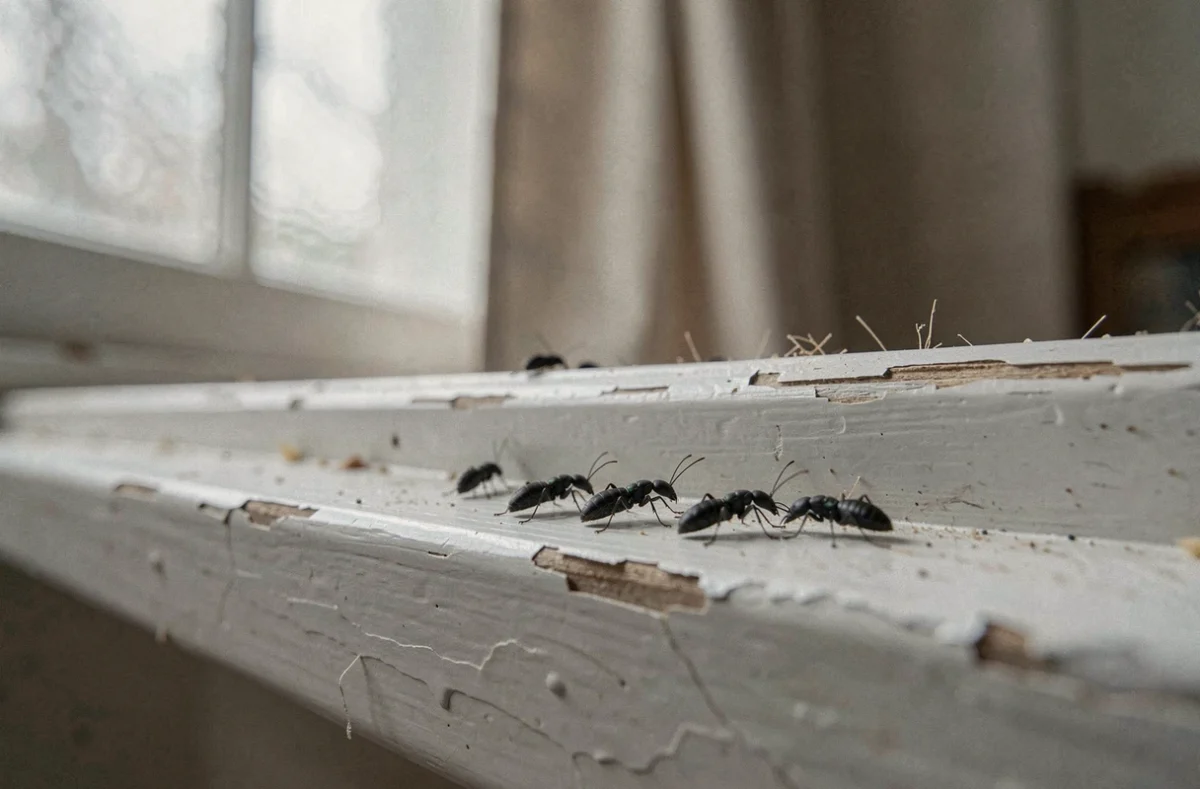
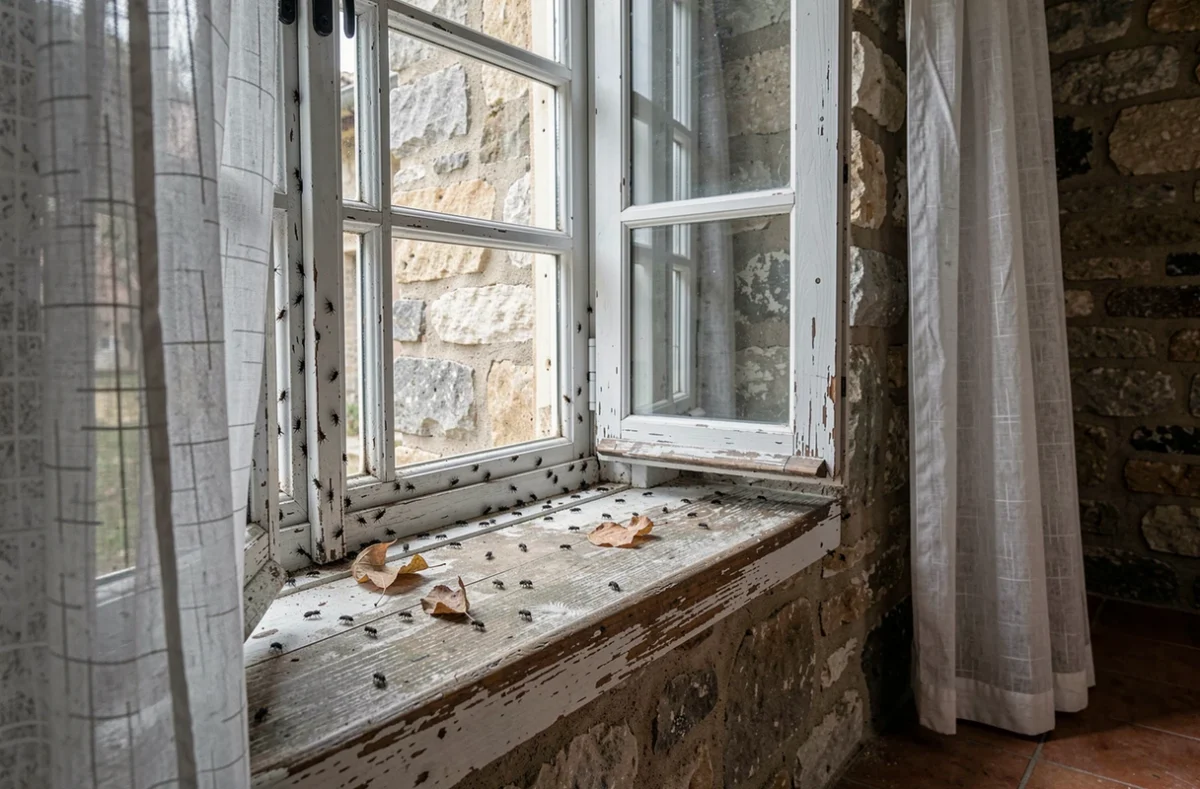
Every year, as temperatures rise, dozens of small black insects appear on window sills. Alive or already dead, they accumulate in just a few days without any obvious explanation. This phenomenon affects both recent PVC joinery and old wooden frames, and its cause varies depending on the species involved, the type of lighting, and the humidity level in the home.
What the size and shape of the insect reveal about its origin
Before addressing anything, the first step is to observe the insect closely, ideally with a magnifying glass or a macro lens on a smartphone. Two families of dipterans are commonly reported on specialized forums: Sciaridae (fungus gnats) and Ceratopogonidae.
Sciaridae measure a few millimeters, have elongated bodies, and smoky wings. They lay their eggs in the moist substrates of houseplants. Their presence on the window sill almost always indicates an overwatered flower pot in the same room or a neighboring one.
Ceratopogonidae are more robust and are sometimes confused with biting midges. They come from outside and are attracted to the glass by the light. They can be identified by their short wings and their tendency to land on curtains and ceilings as much as on the window sill.
If the small black insects on the window sill are mainly found dead in the morning, the hypothesis of light attraction is the most likely. If they are seen alive, buzzing around the plants, the moist potting soil is the starting point of the investigation.

Artificial light and nocturnal mortality of flying insects
Most black insects found on a window sill do not live there. They die after being attracted by the indoor light. This behavior has a name: positive phototaxis. The insect flies towards the most intense light source, hits the glass, exhausts itself, and eventually falls.
A synthesis published by Harvard University in September 2026 indicates that about one-third of insects attracted by artificial lights do not survive until morning. This figure pertains to nocturnal insects in general, but it sheds light on a often overlooked point: the accumulation of corpses on the sill does not mean that the home is infested.
The role of light color
The color temperature of the bulb radically changes the attraction power of a window. Cool white lights (above 4,000 Kelvin) attract more dipterans than yellow or amber bulbs. Replacing a white bulb with a yellow or orange bulb near exposed windows significantly reduces the number of insects attracted in the evening.
This simple action is often more effective than an insecticide spray, which acts after insects have entered the home and not on the cause of their attraction.
Moist potting soil and organic matter: conditions that promote proliferation
When black insects are alive and buzzing around the room during the day, the phototaxis hypothesis no longer holds. One must look for a breeding source inside the home.
The potting soil of houseplants is the first area to inspect. Sciaridae lay their eggs in the top few centimeters of moist substrate. Excessive watering or a pot without sufficient drainage creates ideal conditions. The larvae feed on decomposing organic matter and microscopic fungi present in the potting soil.
A few checks can confirm or rule out this hypothesis:
- Push a finger into the potting soil: if it is constantly moist on the surface, the watering is probably too frequent
- Examine the base of the stems: the presence of small translucent larvae (a few millimeters) confirms active Sciaridae laying
- Check the saucers under the pots: stagnant water in the saucers constitutes a secondary breeding ground often overlooked
The most direct solution is to allow the potting soil to dry out on the surface between waterings and to replace the top few centimeters of substrate with coarse sand, which offers no laying support.
Micro-cracks and roller shutter boxes: invisible entry points
Even without houseplants and with appropriate lighting, some homes continue to accumulate black insects on the window sills. In this case, one must inspect the joinery itself.
Roller shutter boxes are a frequent entry point. The space between the box and the wall offers a temperate micro-habitat, sheltered from the wind, where some insects can nest. Defective seals or micro-cracks around the window frame then allow insects to pass from the box to the interior.
Running a hand along the frame, with the window closed, can sometimes feel a slight draft that betrays a sealing defect. A self-adhesive foam seal or silicone caulk is often enough to seal these passages.
The insecticide trap as a first response
Using an insecticide spray is a common reflex. In France, biocidal products intended for the control of insects (category TP18) are regulated by European legislation. The professional application of certain biocides requires a Certibiocide certificate.
For an individual, the insecticide treats the symptom without addressing the cause of entry. If the insects are coming through a poorly sealed shutter box, they will return after each spraying. The priority remains to seal the entry points and eliminate the favorable conditions (humidity, organic substrate, cool white lighting).
Insect screens and physical exclusion: the most sustainable measure
The most reliable method to prevent the accumulation of black insects on a window sill remains physical exclusion. A fine mesh insect screen blocks entry without resorting to any chemical products.
Fixed or retractable insect screens adapt to most joinery, including those equipped with roller shutters. For roof windows, specific models exist with clip-on frames. The mesh must be fine enough to block Ceratopogonidae, which are smaller than a typical mosquito.
Combining an insect screen with amber lighting near exposed windows and well-drained potting soil for houseplants addresses the three main causes of the phenomenon. Prior identification of the insect remains the starting point: without knowing whether one is dealing with a Sciarid, a Ceratopogonid, or another dipteran, the measures may miss the target.