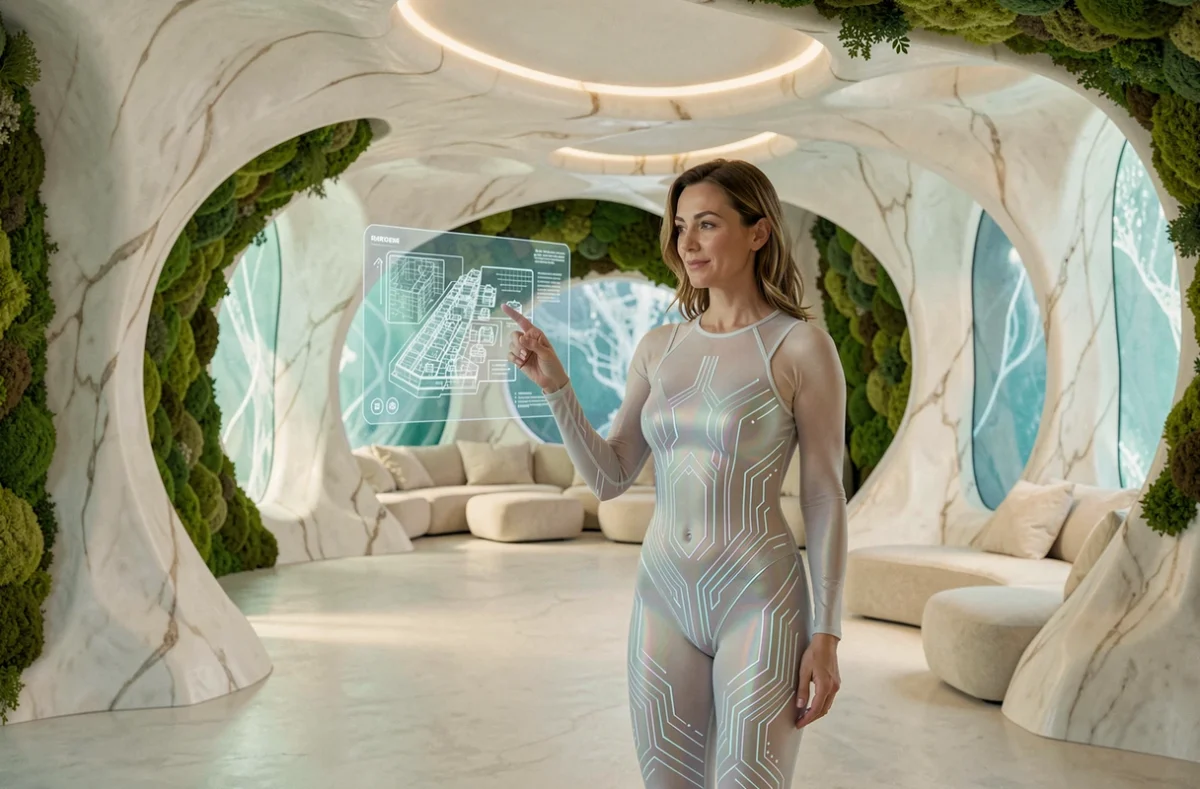
Imagine waking up without an alarm, as your surroundings adjust the light and temperature to match your sleep cycle. This kind of comfort, already hinted at by today’s smart home technology, could become the norm in the year 3000.
Projecting our daily lives a millennium into the future is speculative, but some well-documented trends point to possible directions. Between changes to the human body, the transformation of our homes and a redefinition of our relationship with the planet, everyday life in the future will probably look like nothing we know today.
Climate projections and habitable land in the year 3000
Before we talk about flying cars or domestic robots, one question determines everything else: where will we live? The IPCC synthesis report indicates that sea levels will continue to rise for several centuries, even after 2100. Under a very high emissions scenario, sea level rise could exceed the ranges currently projected by 2300.
Extrapolated over a millennium, this phenomenon would redraw coastlines. Coastal cities like the ones we know today would either be protected by colossal infrastructure or abandoned. Everyday life in the year 3000 would therefore depend first and foremost on decisions made long beforehand, over the coming centuries.
Understanding what the world will be like in 3000 means taking this fundamental climate factor into account, as it will shape agriculture, urban planning and migration patterns over the very long term.

Population in the year 3000: a smaller humanity?
Have you noticed that population projections often contradict the idea of an overcrowded Earth? According to the UN’s World Population Prospects 2024, the global population is expected to keep growing until the mid-2080s, then decline slightly by 2100.
No reliable model can describe the population in the year 3000. The trend toward slower population growth, already measurable in many countries, could continue. If so, everyday life would not resemble a human anthill, but rather a dispersed humanity, with population densities varying widely from one region to another.
How this could affect everyday life
A declining population would change the very structure of cities. Less pressure on land, repurposed spaces, and areas that were once urban returned to nature. Everyday life could look more like that of self-sufficient communities connected by digital networks than life in sprawling megacities.
Competitors often imagine gigantic skyscrapers and inhabited underground levels. This vision assumes continuous population growth, which current data does not support.
The human body and technology: the limits of speculation
The Mindy model, created by Toll Free Forwarding, offers a vision of humans in the year 3000: a hunched back, a thicker neck, hands deformed by intensive screen use, and a second eyelid to protect against artificial light. Widely shared online, this model illustrates a scenario in which the body adapts to tools rather than the other way around.
Such a scenario assumes that our interfaces will remain similar for a thousand years, which is unlikely. Today’s technologies will seem as archaic in the year 3000 as Sumerian clay tablets do to us. The real question is how biological evolution will unfold alongside deliberate changes to the body.
What biotechnology could change
If genetics advances as much over the coming decades as it has in recent ones, humans in the year 3000 may have deliberately modified their own biology. Everyday life could then include:
- Enhanced sensory abilities, such as vision extending beyond today’s visible spectrum, thanks to genetic modifications or biological implants integrated from birth
- Greater resistance to disease, made possible by genome editing becoming commonplace, much like vaccination is in our time
- A direct interface between the brain and computer systems, eliminating the need for screens, keyboards or any other physical intermediary
Screens as we know them would probably no longer exist. Everyday life would unfold through mental interactions with ubiquitous artificial intelligence.

Energy and housing: everyday life beyond fossil fuels
By the year 3000, fossil fuels would be a distant memory—not by ecological choice, but simply because the reserves had run out. Everyday life would rely on energy sources we are only beginning to explore.
If mastered, nuclear fusion could provide abundant, relatively clean energy. Homes would become energy self-sufficient, with each structure generating and storing its own power.
What a typical day might look like
In the morning, there would be no electricity bill to deal with. The home would regulate itself. Food would come from growing systems integrated into buildings or from molecular synthesis. Transport, if it still existed in physical form, would require no fuel and no road infrastructure as we know it.
Work, in the sense of exchanging time for pay, would probably have disappeared or taken a radically different form. Artificial intelligence would manage production and logistics. Human activity would focus on creativity, exploration and social relationships.
Space colonization and life beyond Earth
Everyday life in the year 3000 would not be limited to our planet. If humanity survives that long, some people could live on other celestial bodies or in orbital stations.
For these communities, everyday life would be shaped by radically different physical constraints: reduced gravity, artificial light cycles, and limited resources recycled in closed loops. Living beyond Earth would change the very concept of a day.
On Mars or elsewhere, the distance from Earth would require complete self-sufficiency. The inhabitants of these colonies would develop their own cultures, their own rhythms of life and probably their own relationship with time.
A thousand years is the distance that separates us from the year 1000. Back then, no one could have imagined a smartphone or a transatlantic flight. Everyday life in the year 3000 will be just as unimaginable from our perspective today. Climate, demographic and technological trends point to possibilities, not certainties. The only thing we can be fairly sure of is that daily life in the year 3000 will have almost nothing in common with ours.