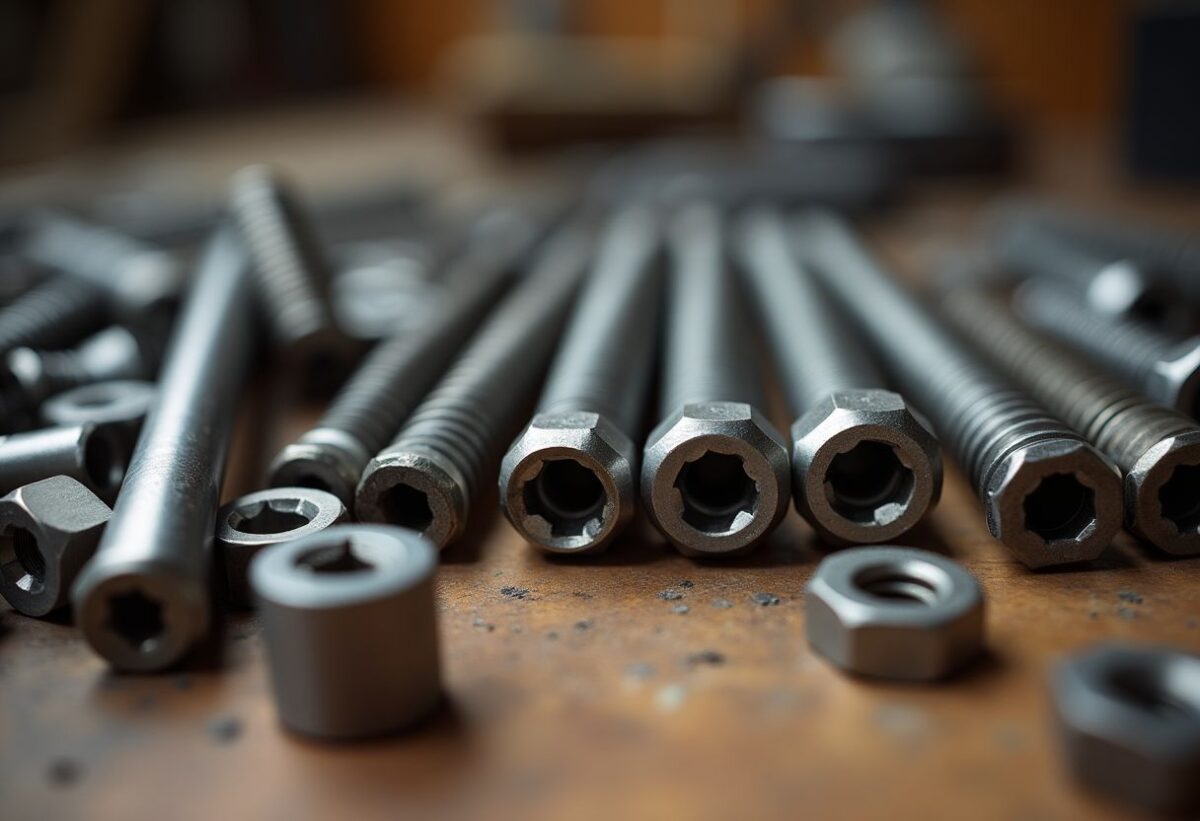
CHC screws, also known as hexagonal hollow cylindrical head screws, have become an essential element in the fields of mechanics and construction. Behind their simple appearance lies a world of complexity and ingenuity. Professionals and DIY enthusiasts know well: their presence often signifies reliability and efficiency. Why such enthusiasm for these metal tools? What are the secrets of their success and how have they managed to establish themselves in such diverse sectors as the automotive industry, aerospace, and modern architecture?
History and Evolution of CHC Screws
CHC screws have not always been as popular as they are today. Their history is a testament to technical and industrial evolution over the centuries.
The invention of CHC screws dates back to the early 20th century, a period during which the mechanical industry was experiencing significant growth. The demand for robust and reliable fastening parts was increasing. It was in this context that these screws were designed to meet increasingly stringent requirements for strength and safety. They quickly gained popularity thanks to their ingenious design. The hexagonal hollow cylindrical head allows for optimal force distribution, ensuring a solid and durable fastening.
- Technological Evolution: Over time, the materials used for manufacturing screws have evolved. Special alloys have been developed to enhance their strength.
- Standardization: Standardization has enabled mass production and large-scale use in various industrial sectors.
Technical Characteristics of CHC Screws
The technical features of CHC screws make them a preferred tool for many applications. Understanding these characteristics is essential for optimal use.
- Head Design: The cylindrical hexagonal head ensures a secure grip, facilitating the application of torque.
- Manufacturing Materials: Often made of stainless steel or titanium, these materials provide resistance to corrosion and wear.
- Standardized Dimensions: Available in various sizes, they adapt to a wide range of applications, ensuring universal compatibility.
These technical specifications make CHC screws an indispensable element for assemblies requiring high reliability.
Practical Applications of CHC Screws
CHC screws play a crucial role in many sectors, and their application is not limited to a single function. Their versatility makes them a preferred choice in various projects.
In the automotive industry, they are often used to assemble critical parts of the engine, ensuring optimal safety. In modern architecture, they consolidate metal structures, thus providing increased stability to constructions. For DIY enthusiasts, they represent an ideal solution for modular furniture or installations requiring robust fastenings. Aerospace, for its part, relies on their lightweight and strength to manufacture complex structures, thereby contributing to the safety and performance of aircraft.
Each application area highlights the unique advantages of CHC screws, whether it be their strength or ease of use.
Choosing and Using CHC Screws: Practical Tips
Choosing the appropriate CHC screws and knowing how to use them effectively is crucial to getting the most out of them. Practical tips can help optimize their use.
Before starting any project, it is essential to select screws suitable for the specific materials and mechanical constraints. Although they are versatile, the choice of size and material must be made carefully. When installing, using the appropriate tool to avoid damaging the hexagonal head is essential.
Finally, regular checks of the condition of the fastenings ensure their durability. Proper maintenance extends their lifespan, thus ensuring the safety of the assembled structures.